Flow Straight to Reality: Perceptually Consistent Flow Matching for Efficient Image Restoration
Sangwoo Jo, Donggeun Ko, Jayeon Kang, Youngsang Kwak, Jaehwa Kwak, Sungjoon Choi
European Conference on Computer Vision (ECCV), 2026 Paper Code
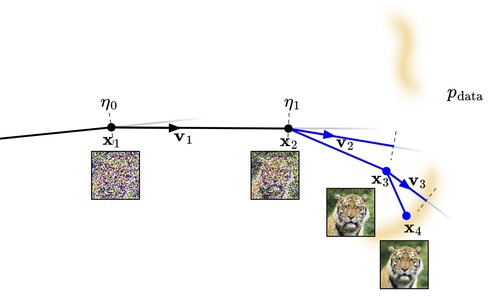
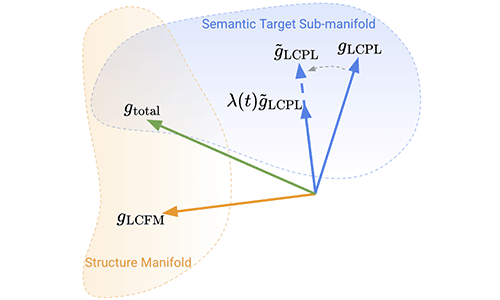
Image restoration is fundamentally constrained by the tradeoff between distortion and perception: minimizing pixel-wise error yields over-smoothed results, whereas optimizing for perceptual realism often introduces structural deviations. Recent approaches attempt to balance this tradeoff via posterior sampling or multi-stage generative pipelines, yet remain computationally expensive and architecturally complex. To overcome these limitations, we propose PCFlow (Perceptually Consistent Flow Matching), a unified framework that directly parameterizes a continuous transport from degraded observations to clean targets, jointly optimizing distortion and perceptual quality. While its latent consistency flow objective drives stable and efficient few-step inference, a Latent Consistency Perceptual Loss (LCPL) imposes semantic constraints directly on the guiding velocity field, steering the dynamics toward visually sharp data manifolds. Furthermore, recognizing the inherent conflict between trajectory and perceptual consistencies, we integrate a conflict-free gradient projection strategy to stabilize the multi-objective optimization landscape. Combined with lightweight, convolution-only backbone, PCFlow achieves competitive performance across diverse restoration tasks at a fraction of traditional computational costs.